
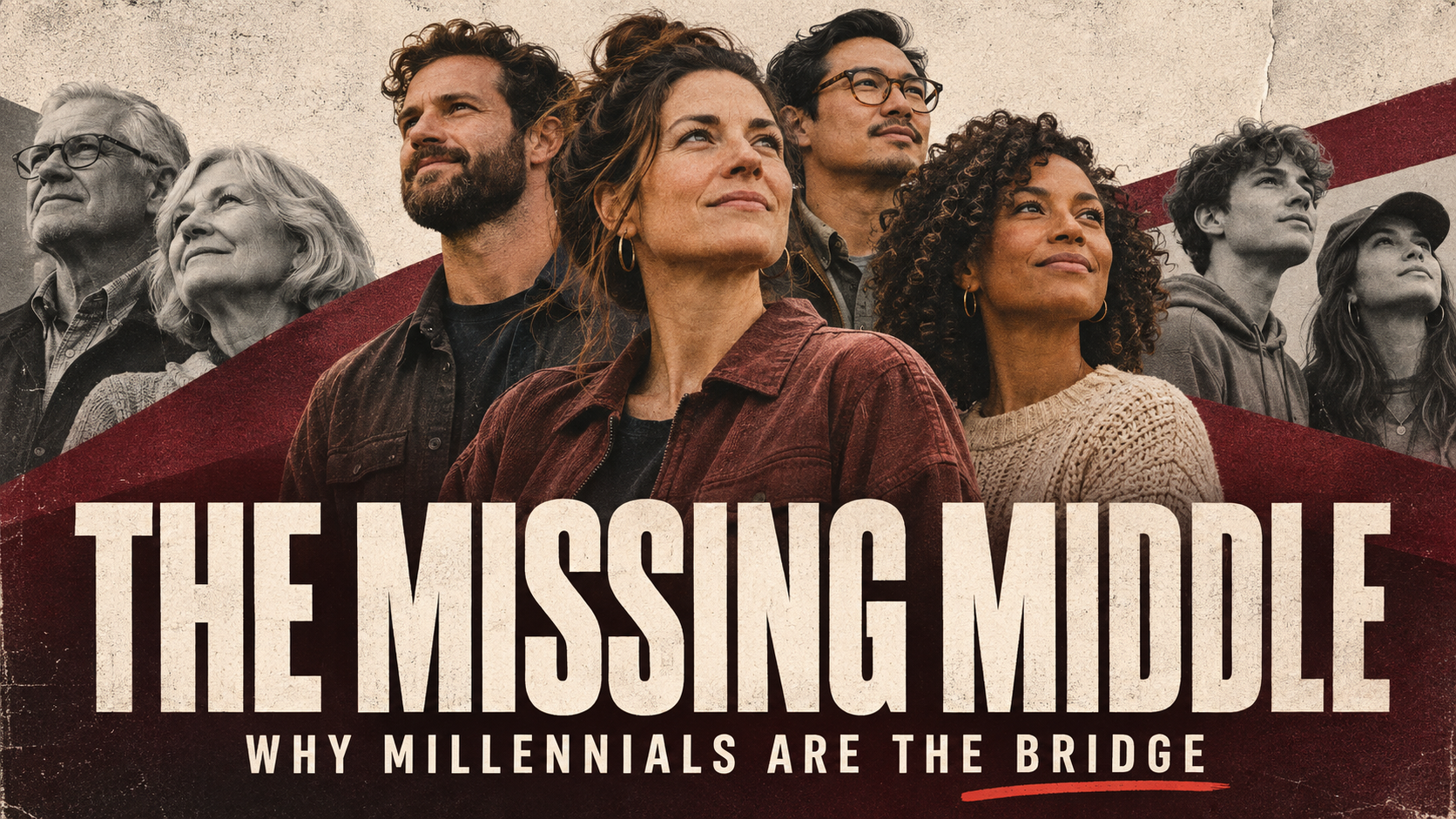
Ministries are pulled between two audiences. Boomers are the donors who keep the lights on. Gen Z is the future everyone talks about at conferences. In between sits the generation most ministries skipped: Millennials, now in their 30s and early 40s.
I'm a Millennial myself. After a year of looking at ministry media data, I think my generation is the audience ministries most need to reach right now.
Why ministries keep producing for Boomers
It makes sense on paper. Boomers are the most generous generation by far. In a 2025 Giving USA and Dunham+Company study, Boomer donors gave an average of $3,256 a year, twice as much as Millennials. They also respond to the channels ministries already use: 28% of Boomer donors made an online gift in response to direct mail, a rate 50% higher than any other generation.
So the TV-style shows, the long teachings and the direct-mail appeals all keep serving the people who pay for them. The trouble is that this audience is aging, and nothing is replacing it.
Millennials just moved
The biggest shift in this year's Gallup numbers came from Americans aged 35 to 54, a group that includes most Millennials.
| Americans aged 35 to 54 | Sympathize more with Israelis | Sympathize more with Palestinians |
|---|---|---|
| 2025 | 45% | 33% |
| 2026 | 28% | 46% |
That is a 17-point drop in one year, a bigger swing than among 18 to 34 year olds, who went from 29% to 23%.
This didn't come out of nowhere. In 2017, when Millennials were the 18 to 34 bracket, LifeWay Research found that only 58% of younger evangelicals had a positive view of Israel, compared with 76% of older evangelicals, and 41% had no strong views at all. LifeWay's director summed it up in one word: indifferent.
Ministries saw the drift a decade ago and kept making content for Millennials' parents.
Why Millennials are the better bet right now
Ahead of Gen X at $1,371
vs. about 30% of Gen X and Boomers
They give more every year. Millennial donors gave an average of $1,616 in 2024, ahead of Gen X at $1,371, and the gap is growing.
They show up. 43% of Millennial donors attend religious services in person every week or almost every week, compared with about 30% of Gen X and Boomer donors.
They give online. Younger donors are far more likely to give in response to content on a ministry's website or an ask on social media. A clunky mobile giving form loses them.
They are next in line for the money. Some estimates put the charitable share of the coming wealth transfer at $18 trillion by 2048.
They are the bridge. Millennials are the parents of Gen Alpha, the youth pastors, the small group leaders and the older siblings of Gen Z. Reach a Millennial and you influence a household. Most of what ministries want for Gen Z will travel through them.
What Millennials need from you
Many Millennials grew up inside the evangelical culture these ministries come from. Some still love it. Some walked away from parts of it. Almost all of them have opinions. That calls for a different approach from the one that works with Boomers.
- Talk to them as adults. They are not "young people" anymore. They are raising kids, running businesses and leading in their churches.
- Be honest about the hard questions. Research on younger evangelicals shows they are strongly moved by fairness, and that pressure to support a position tends to push them away from it. Name the hard questions and answer them straight.
- Show up where they are. Podcasts, long honest conversations, Instagram, YouTube on their phones. In our data, conversation-led faith channels grew their audiences by 45% to 113% last year while most established ministry channels grew under 5%.
- Make giving simple and show the impact. Next-generation donors are issue-driven and prefer flexible giving with fewer strings attached, according to Indiana University's Lilly Family School of Philanthropy. Show them what their giving does, and let them do it in under a minute on a phone.
Gen Z is the long game. Millennials are the next five years.
Keep building for Gen Z. It matters, and the research on reaching them is clear (see why most Gen Z channels end up reaching parents). But if your donor base and your content are both built for Boomers, the generation you need to win next is already in the room, with the income, the church attendance and the influence over the kids you hope to reach.
Maroon Harpoon
Know who is watching and giving.
We build media and fundraising for the generation that comes next. Start with a reach audit.
Book a reach auditSources: Gallup, 2026; LifeWay Research, 2017; Giving USA and Dunham+Company generational giving study, 2025, via The Chronicle of Philanthropy and MinistryWatch; Indiana University Lilly Family School of Philanthropy, The Next Generation of Philanthropy, 2025; DAFgiving360; channel data from public YouTube statistics, 12 months to November 15, 2026.
Want work like this for your organization?
Let's talk about what a real creative partnership looks like.
Get in touch