Jerusalem Seminary
Process
Overview
Jerusalem Seminary is a graduate school in Jerusalem built on a simple conviction: the Land is the classroom and the Bible is the guide. In 2026 it merged with the University of the Holy Land, a 40-year-old graduate school, and the two became one institution with three schools: the School of the Bible, the School of Graduate Studies, and the School of Hebrew (Hebrew for the Nations).
A merger is a moment when people look closely. Current students, donors, prospective students and partner churches all go to the website to find out what changed. Jerusalem Seminary needed that website to tell one clear story, and it needed it in time for the new academic year.
We were their partner for the whole launch: the merger announcement, the Open Day recruitment campaign, paid landing pages, print, and the new website.
The Challenge
What looked like one website was nine separate WordPress installs, plus a second domain for the Hebrew program. Between them they held 241 published pages, each install with its own menus and its own pending updates. Program information was scattered across sites. The privacy policy and terms of use existed but couldn't be found from any menu. The main domain's DNS pointed to a zone nobody on the team was editing, so changes made in the hosting account never took effect.
The calendar made it harder. The seminary had to announce the merger, recruit for the fall through an Open Day, and replace the website at the same time. The old site couldn't carry the announcement, and the new one couldn't wait for a perfect build.
The new site also had to:
- Give three schools distinct identities inside one institution
- Run on a CMS the seminary's own team could update without a developer
- Connect to Populi, the seminary's student system, for inquiries and applications
- Keep every old link working for current students and search engines
Our Approach
- Launch the message first, build the site second. We built a merger announcement site on the new design system and put it on the main domain within days, along with a matching transition page for the University of the Holy Land, with giving consolidated under the seminary. The Open Day campaign ran from it: registration pages, social and ad creative, and the downloadable catalog and calendar. The full website was built behind it without holding anything up.
- Fix what was broken underneath. We traced the DNS to an orphaned zone, moved the nameservers, and cut both institutional domains over to the new sites. The old WordPress site moved to a subdomain where it stays reachable, with redirects so old links land in the right place.
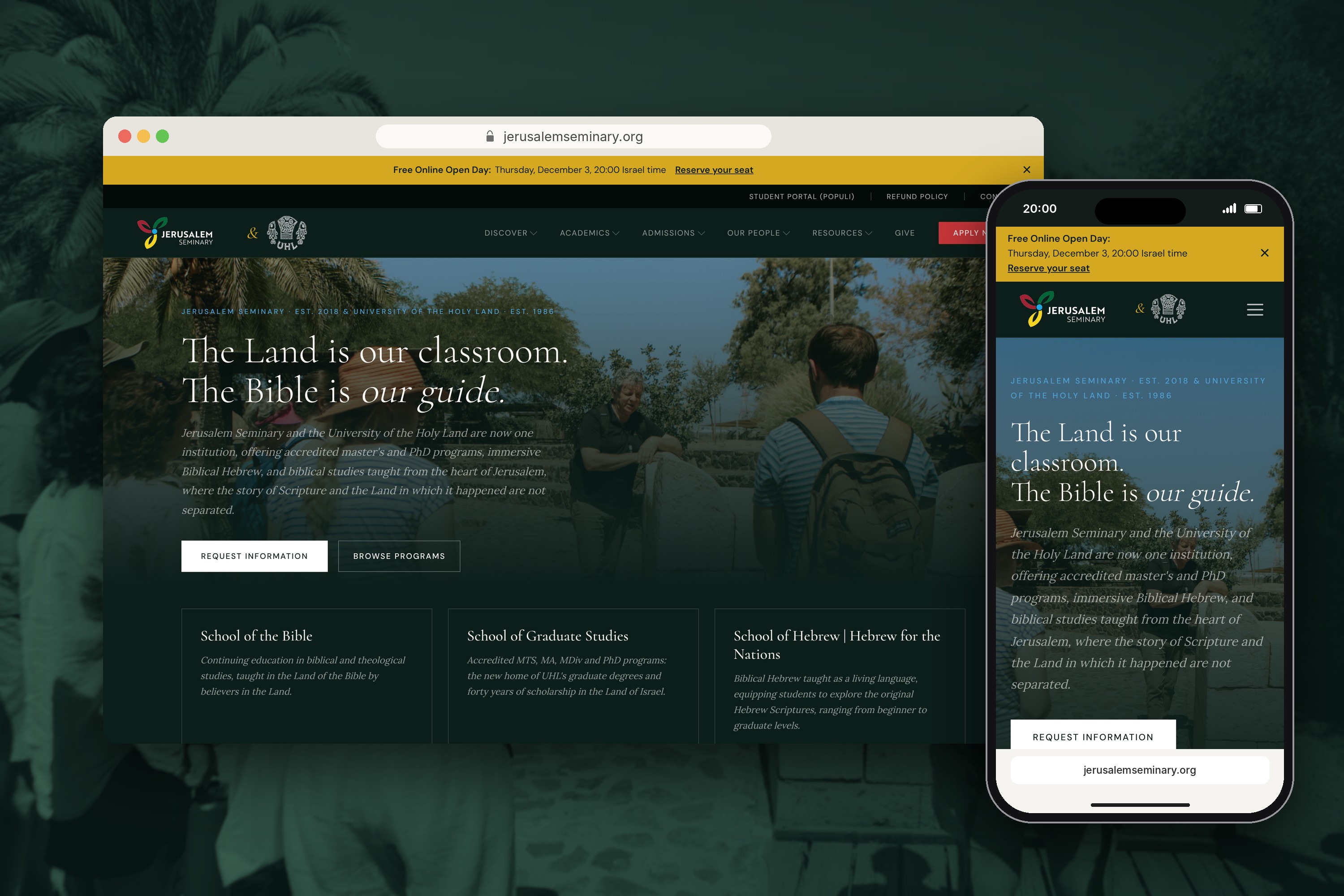
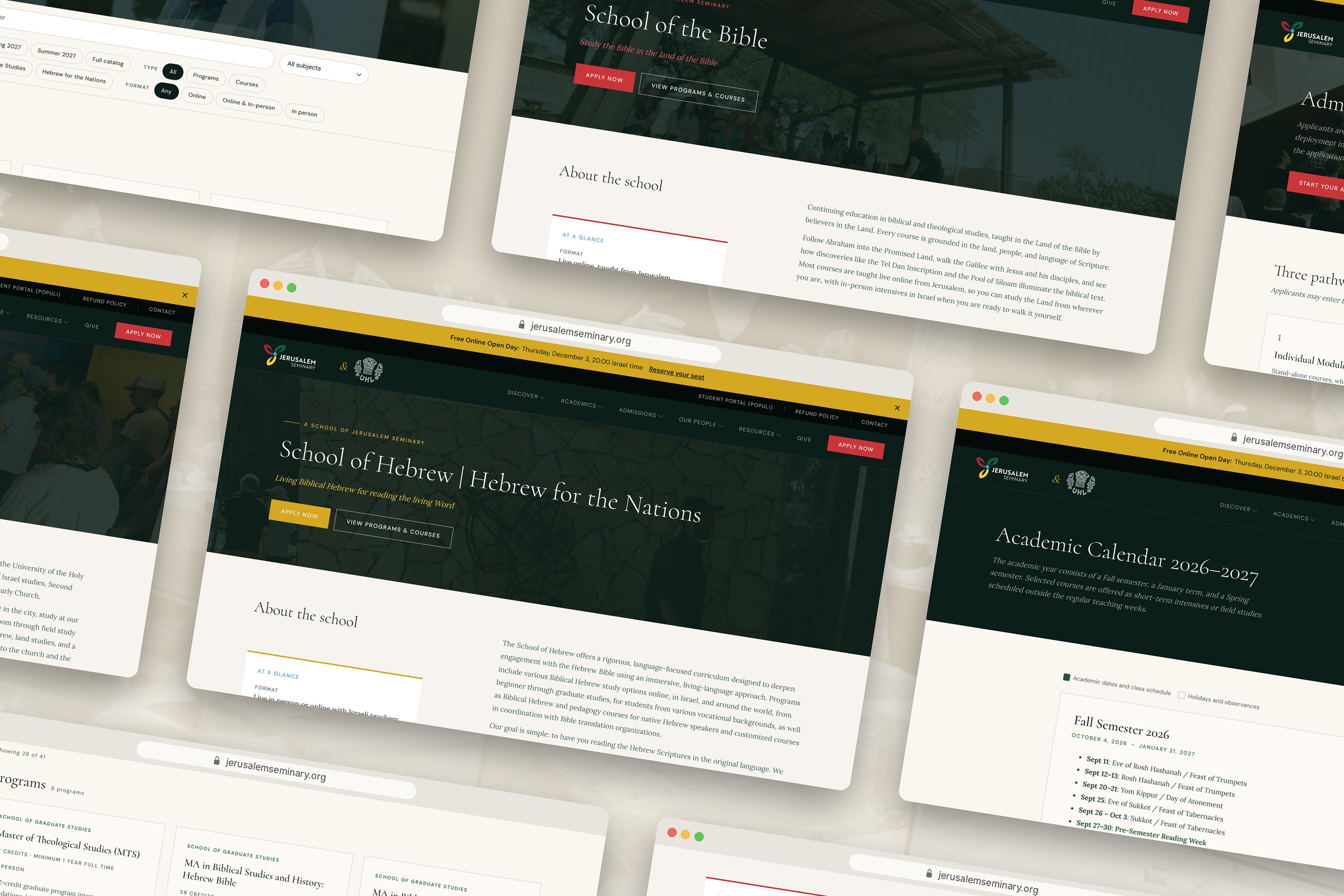
- One site map instead of nine. We cut 241 pages down to 20 core pages under five menus: Discover, Academics, Admissions, Our People, and Resources. Programs, faculty, news, events and the academic calendar moved into the CMS, so each lives in one place and shows up wherever it's needed.
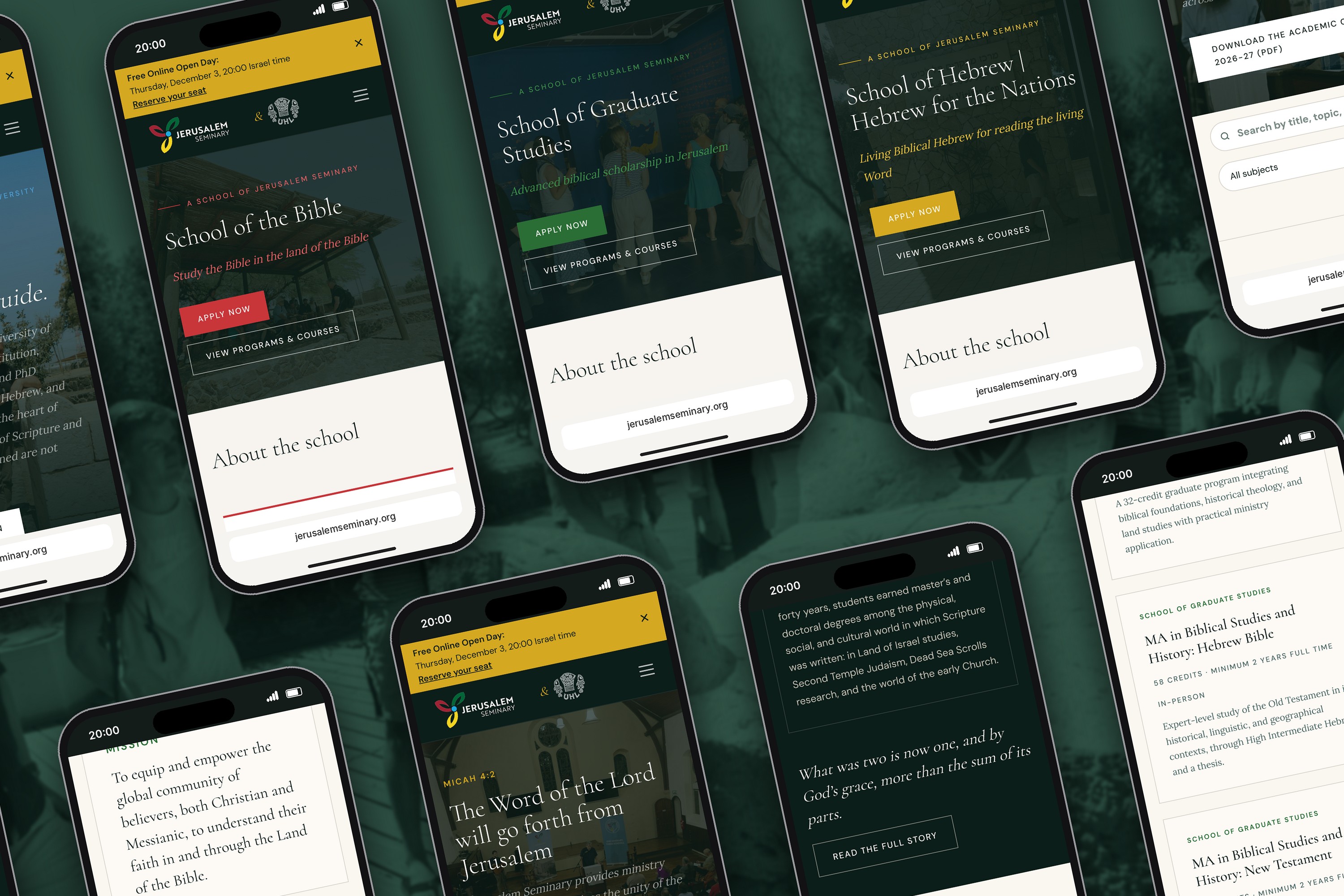
- Three schools, one institution. Each school carries its own accent color (red for the School of the Bible, green for Graduate Studies, gold for Hebrew) through its pages, programs and buttons, all from one template. Visitors always know which school they're in, and the site still reads as one seminary.
- A catalog people can use. All 41 programs and courses sit in one catalog that can be searched and filtered by school, format and level, built from the seminary's actual 2026-27 academic catalog. Where the catalog and calendar disagreed, we flagged it to the seminary instead of guessing.
- Applications that stay on the site. The Populi inquiry form is built into the contact page, and the degree application opens in a window on the admissions page, so prospective students never get sent to another website halfway through applying.
- Show the Land, not the classroom. The seminary's best asset is where it teaches. We built the site around its own field-study photography, from the excavations at Tel Lachish to museum study sessions, so the homepage shows students learning on site.
- A system the team can run. Design tokens for color, type and spacing, shared header and footer components, and eight CMS collections mean the seminary's own staff can add a program, a faculty member, an event or a news post without touching the design.
- The same look everywhere. Alongside the website we produced the Open Day ads and social kits, interim paid landing pages, business cards and program flyers, all from the same design system, so the merged institution looked like one place from the first announcement on.
Results
- Merger live in days, Open Day in ten. The website build started August 10. The merger site and both domain cutovers were live by August 13, and Open Day sessions ran on August 20 and 22, while the full site was still being built.
- From 241 pages to 20. Nine WordPress installs and a second domain became one site with five menus, where visitors can reach any school, program, faculty member or date.
- SEO score from 69 to 100. Accessibility from 82 to 93. Measured with Google Lighthouse on the homepage, old site against new.
- 41 programs in one catalog. Searchable and filterable by school, format and level, replacing program pages scattered across separate sites.
- Applications without leaving the site. Inquiries and degree applications go straight into Populi from forms on the seminary's own pages.
- Policies people can find. The privacy policy and terms of use were hidden on the old site. Now they're linked on every page, which protects online course sales against payment disputes.
- Nothing lost in the move. Both domains were cut over, the legacy site stays reachable, and old links redirect to the right place.
Why this works for institutions in transition
- Your announcement doesn't wait for your website. The merger and recruitment campaign went live first, and the full site followed without a gap.
- One system everywhere. Website, ads, landing pages, business cards and flyers came from one design system, so the merged institution looked like one place from day one.
- Old links keep working. DNS, legacy content and redirects were handled as part of the build.
- Direct access to the person doing the work. The same person ran the strategy, the design, the build and the domain cutover, so nothing was lost between handoffs.